



+1 718 749 7373
Dedicated 7-Day Support (9 AM - 9 PM)
Free US Shipping

Short answer: you cannot stop a cat from scratching, but you can change where it happens. Put a sturdy sisal post, at least 32 inches tall, directly against the spot your cat scratches, cover that spot with a blanket or sheet while your cat learns, reward every scratch on the post, and move the post a little at a time once it is in regular use. Do not punish your cat. In a survey of more than 4,000 cat owners, the owner reactions it asked about (reprimanding, removing or redirecting the cat) did not appear to change how often unwanted scratching happened.
This guide is general information, not veterinary advice. If scratching suddenly increases, or your cat seems stressed or in pain, talk to your veterinarian. Last updated: November 11, 2026.
About this guide: we are an online store, and we do not test the products we sell. This guide summarizes advice from the ASPCA, the Cornell Feline Health Center, VCA Animal Hospitals, Humane World for Animals, the American Association of Feline Practitioners (AAFP) website, PetMD, the American Veterinary Society of Animal Behavior (AVSAB) and a 2016 peer-reviewed owner survey, all listed at the end, and it shows products that are in stock in our store right now. Product details such as height, materials and features come from our suppliers and are not verified by us. Where sources disagree we say so, and where a suggestion is our own we label it.
Scratching is normal cat behavior, not bad behavior. The ASPCA says cats scratch to stretch, to play, to mark territory, to signal to other cats and to remove the worn outer layer of their claws. The Cornell Feline Health Center describes scratching as mainly scent marking, because glands in the paws leave scent on the surface, and says that because the urge is built in, it can be redirected but not removed. PetMD adds that scratching can start as early as 8 weeks of age.
The sofa is an easy target. PetMD says cats tend to go for vertical surfaces such as couch arms, and VCA Animal Hospitals notes that cats prefer to mark spaces they use, which is why a post tucked away in a spare room is often ignored while the sofa in the living room is not. PetMD also says cats return to spots that already carry their scent, so a scratched corner keeps drawing the cat back.
A 2024 study of 855 cats in France, summarized by AVSAB, included only homes that already had at least one scratching post, and the sofa was still the most common unwanted target. A 2016 survey of more than 4,000 cat owners (Wilson and colleagues) found a similar pattern: of the owners who reported unwanted scratching, 69.3% already had a post in the same room as the scratched spot, and about half of those posts were 1 to 5 feet away from it. Both are owner surveys, so they show patterns, not proof. Our own reading, which is not a finding of either study: a post near the sofa is not the same as a post against the sofa, and the steps below start by closing that gap.

Before you buy or move anything, look at where and how your cat scratches, then match the scratcher to that habit. The ASPCA says cats differ in whether they like vertical, horizontal or slanted surfaces, and that once you know your cat's preference you can add more scratchers of that type.
| What you see | What it suggests | What to offer | Source |
|---|---|---|---|
| Claws in a sofa arm or corner, cat standing tall | Vertical scratching | A tall, sturdy sisal post placed directly against that spot | Humane World, VCA, Cornell |
| Scratching the seat, the rug or the carpet | Horizontal scratching | A flat sisal or cardboard scratcher, or a sturdy post laid on its side | Cornell, Humane World |
| Scratching curtains or door frames | Wants a tall, hanging-style surface | A tall wall- or door-mounted scratcher | Cornell |
| Scratching right after waking up | Stretching after sleep | A scratcher beside the bed or favorite nap spot | PetMD, AAFP |
| Scratching in several places | More than one favorite spot | A scratcher near each spot | Cornell |
| Older cat that used to scratch upright | Preference may shift from vertical to horizontal with age | Add a horizontal scratcher | AAFP |

Humane World for Animals, VCA and Cornell all say to start by placing the post right next to the furniture your cat already scratches, and VCA says to put it directly against that spot. Once your cat uses it, you move it gradually to where you want it to live (Step 4).
Humane World for Animals says a post should be at least 32 inches tall. Cornell gives a way to size it for your own cat: the post should be at least as tall as your cat standing on its hind legs with its front legs stretched out. The ASPCA and PetMD say only that the post must let the cat stretch fully. In the 2016 survey, owners whose most-used post was taller than 3 feet reported unwanted scratching less often (55.2% of homes) than owners with smaller posts (64.7%). That is an association in self-reported data, not proof that height alone fixes the problem.
The ASPCA says the post must not shift or tip when your cat uses it, and PetMD says a sturdy base matters because a tipping post can frighten or injure a cat. Our own suggestion: after you assemble it, push on the top. It should not rock or lift off the floor. Look for a stated base size and weight in the listing, and if the page does not give them, ask us before you buy.
Humane World for Animals prefers sisal rope, and says cardboard and wood can also work if they are tall or long enough and sturdy. Cornell says to match the material to what your cat already scratches: sisal or rope-like surfaces suit cats that go after couches or nubby fabric, and carpet-covered posts suit cats that scratch carpet. The ASPCA suggests offering several materials at first and watching which one your cat prefers. In the 2016 survey, owners whose cats' favorite post was wrapped in rope reported unwanted scratching less often (53.7%) than owners whose cats favored cardboard (60.2%), carpet (63.1%) or wood (64.4%). Again, this is an association in a self-reported survey.
The picks below are chosen by hand. Only products that are currently in stock are shown, and prices and options always match the product page.
Before you buy: height, base size, material and any weight limit come from the supplier, so check them on the product page against the points above. Some listings include a hanging toy or a catnip ball. If a listing does not state something, do not assume it. Our refund policy explains what happens if an item is not right for your cat.
Cornell says cats that scratch drapes need a tall post, such as a wall- or door-mounted one. If floor space is tight, a wall-mounted or floor-to-ceiling scratcher uses less of it. Our own cautions: a floor-to-ceiling pole needs a ceiling that can take the pressure, so measure the height first, and a wall mount only works if you can fix it firmly to your wall.
If you have more than one cat, PetMD recommends several posts placed in social areas. The 2016 survey's abstract reports that unwanted scratching decreased as the number of post types in the home increased. A tower can add a perch and a hideaway to the scratching surface, but check that every level is stable before you rely on it.
Before you buy: the supplier listings for some of these do not state every detail, for example the materials or full specifications, so read the whole product page. Heights and weights are the supplier's figures.

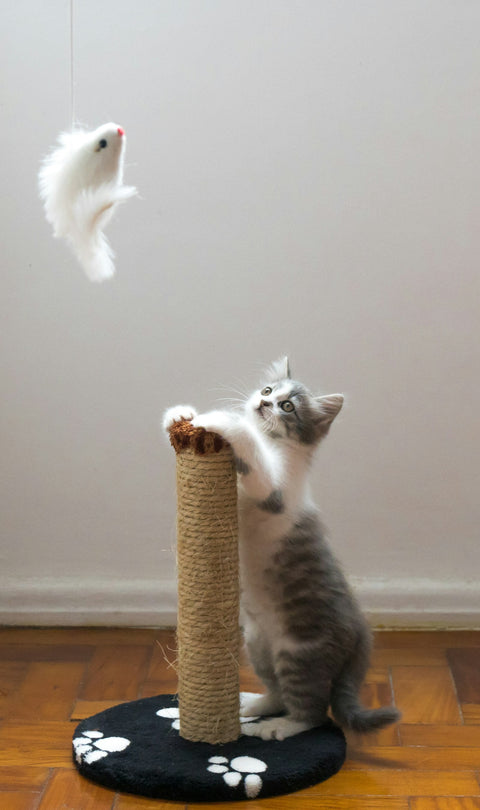
A post only works if your cat wants to use it. The ASPCA suggests scenting the post with catnip and hanging a toy on it. Humane World for Animals suggests playing with your cat next to the post using a fishing-rod style toy or a laser light so that the cat interacts with it, and rubbing catnip on the post for the first several days. PetMD suggests running your own fingernails along the post to show your cat what to do.
Reward your cat when it scratches the post. PetMD lists catnip, treats or praise, and the AAFP website recommends rewarding at the moment the cat uses the scratcher. In the 2016 survey, owners who rewarded their cats in any way more often reported that the cat used its favorite post at least daily (80.4%) than owners who never rewarded (67.7%).
Never carry your cat to the post and rub its paws on it. Humane World for Animals, the ASPCA and PetMD all warn that this can stress your cat and make it avoid the post.
Before you buy: catnip strength and toy materials are the supplier's claims. Our own suggestion: supervise play with strings, feathers and small parts, and put wand toys away when you are done.

Cornell says the only guaranteed way to keep a cat off a surface is to restrict access. For the weeks while your cat is learning, make the old spot less appealing at the same time as the new spot is more appealing. The sources agree on the idea but not on every method:
| Option | What the sources say | Watch out for |
|---|---|---|
| Throw blanket or tight-fitting sheet | Humane World says a tight-fitting sheet is much less appealing to scratch than sisal. Cornell lists blankets, and the AAFP website lists throw blankets. | Remove it once your cat uses the post consistently (Humane World). |
| Plastic cover or furniture protector | The ASPCA lists plastic covers. The AAFP website lists a commercial plastic furniture protector. | Check that it stays in place and does not slide off. |
| Double-sided sticky tape | The ASPCA, Cornell, PetMD and Humane World (for smaller surfaces) list it. The AAFP website advises against it as a deterrent. | The sources disagree. Start with covers. If you try tape, test a hidden patch first (our suggestion). |
| Post placed against the scratched spot | VCA suggests putting the post directly against the furniture so that it blocks access to that spot, and Humane World suggests putting it next to the couch. | Make sure it is stable there. |
| Enzymatic cleaner on the scratched area | PetMD says to use an odor-neutralizing enzymatic cleaner, and Cornell recommends an odor neutralizer, because scent draws cats back. | Follow the cleaner's directions for your fabric. |
| Pheromone products | PetMD describes spraying a synthetic facial pheromone on furniture, and VCA mentions veterinarian-approved calming pheromones for anxious cats. | The pages we read do not give evidence of how well they work, and they may not work for every cat. Ask your veterinarian. |
Skip homemade citrus or essential-oil sprays. PetMD lists citrus sprays as a deterrent, but VCA lists citrus among the essential oils that are poisonous to cats, which can swallow them while grooming or absorb them through the skin. If your cat is exposed, VCA says to call your veterinarian or the Pet Poison Helpline (1-800-213-6680) right away.
Cornell and VCA both say that once your cat is using the post, you move it gradually to its permanent spot, rather than all at once. Humane World for Animals says to remove the sofa covering once the cat consistently uses the post. If your cat scratches in several places, Cornell says to provide a post near each one.
Do not rush to throw away a shredded post. The ASPCA says cats often prefer one that looks and smells familiar, and Cornell says heavy wear shows the post is being used. Replace it when it becomes unstable or unsafe.
| When | What to do |
|---|---|
| First days | Put the post against the scratched spot, cover the spot, scent the post with catnip and play next to it. |
| Next one to two weeks | Reward every use. Clean the old spot with an enzymatic cleaner. Keep the cover on. |
| Once your cat uses the post every day | Move the post a short distance, then wait a day or two before moving it again. |
| After the post is in its final spot | Keep the cover on a little longer. Take it off once the sofa is no longer being scratched. |
This schedule is our own suggestion. None of the sources we read gives exact timings, and cats differ. The AAFP website notes that changing behavior takes patience and consistency.

Many cats scratch as soon as they wake up, and PetMD and the AAFP website both suggest placing a scratcher near where your cat sleeps. VCA adds that hiding spots, toys or elevated perches near a post can make it more appealing. If your cat naps on the sofa, a bed or hideaway placed beside the post gives the cat a reason to be there.
Before you buy: claims such as "scratch resistant" or "reduces anxiety" are the supplier's wording and we have not verified them. Check the size and the weight limit on the product page.
Trimming reduces damage, but PetMD says it will not stop scratching, so pair it with redirection. Cornell describes the method: gently squeeze the paw to extend the nail, cut at an angle that removes the sharp hook at the tip, and avoid the quick, the pink tissue inside the nail base that contains blood vessels and nerves. If you are unsure, ask your veterinarian or a groomer to show you.
Plastic nail caps are glued on, and the sources differ on how long they last. The ASPCA says about four to six weeks, and Cornell says to replace them every 6 to 12 weeks and to use them only on cats that tolerate paw handling. Ask your veterinarian before you try them.
The AAFP website says increased scratching can be a sign of distress. PetMD lists stress, boredom, new pets, changes in the home and a worn-out scratcher as common triggers, and VCA says anxious cats may scratch furniture more often. Talk to your veterinarian if scratching suddenly increases or you notice other changes in your cat's behavior. For a problem that does not improve, the ASPCA suggests a Certified Applied Animal Behaviorist or a board-certified veterinary behaviorist.
Not by itself. In the 2024 French study, every home had at least one post and the sofa was still the most common unwanted target. Placement, height, stability, rewards and temporary protection for the sofa all matter.
Humane World for Animals says at least 32 inches. Cornell says at least as tall as your cat standing on its hind legs with its front legs stretched out.
The sources disagree. The ASPCA, Cornell, PetMD and Humane World list it, and the AAFP website advises against it as a deterrent. A blanket, sheet or plastic cover is a safer place to start.
PetMD says scratching stretches the body and relieves muscle tension, and it suggests placing a scratcher near the cat's bed because many cats scratch after waking.
None of the sources we read gives a timeline. The AAFP website says changing behavior takes patience and consistency.
No. PetMD says scratching can begin as early as 8 weeks. Our own suggestion: choose a stable post and keep strings and small parts out of a kitten's reach.
No. The ASPCA opposes it, and Cornell says it does not reduce the urge to scratch.
Put a tall, stable sisal post against the sofa, cover the sofa for a while, reward every use, move the post slowly and never punish. If you are still choosing a post, read our buyer's guide to cat scratching posts, browse the cat scratching posts collection, or see the rest of our cat supplies. Our shipping policy explains delivery.


