
+1 718 749 7373
Dedicated 7-Day Support (9 AM - 9 PM)
Free US Shipping

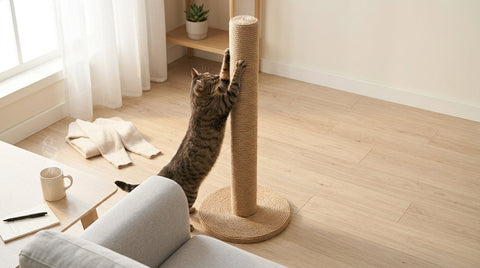
Short answer: for most indoor cats, choose a scratching post that is tall enough for a full-body stretch, stable enough that it never wobbles, and wrapped in a durable rough material such as sisal. Put it where your cat already likes to scratch, and reward your cat for using it. The rest of this guide explains each step, compares the main types, and lists the scratching posts and cat towers currently in stock in our store.
About this guide: we are an online store, and we do not test every product ourselves. This guide summarizes advice from the veterinary and animal-welfare sources listed at the end, and shows products that are available in our store right now.
Scratching is normal cat behavior, not misbehavior. According to the ASPCA, cats scratch to stretch and play, to mark territory, to signal to other cats, and to shed the worn outer layer of their claws so sharper ones show. The American Association of Feline Practitioners (AAFP) also describes scratching as normal and recommends giving cats suitable places to do it, rather than trying to stop it altogether.
That is why the goal is not to stop your cat from scratching. The goal is to give your cat a better place to scratch than your sofa.
| Type | Best for | Watch out for |
|---|---|---|
| Tall sisal post | Cats who like to stretch up and scratch vertically | A light or narrow base that tips over |
| Scratching tower or cat tree | Climbers and homes with more than one cat | Needs floor space; check that the platforms do not wobble |
| Floor-to-ceiling post | Large cats and homes with limited floor space | Measure your ceiling height first; needs a solid ceiling |
| Wall-mounted or flat scratcher | Small apartments, and cats who prefer horizontal or angled scratching | Wall mounts must be fixed firmly; not every wall suits one |
Every source we checked agrees on the basics: height, stability, surface, and matching your cat's own habits. Exact numbers vary between sources, so treat them as starting points and watch your own cat.
The ASPCA and PetMD both say the post should let your cat stretch out fully, but neither gives a number. Webvet's buying guide suggests a scratchable surface of at least about 32 inches (81 cm) for an average adult cat, and more for larger cats. To size it for your own cat, mark how high your cat reaches with its front paws while its back feet stay on the floor, then add 2 to 3 inches. Webvet also notes that you should count only the continuous scratchable surface, not the total height of a tower.
A post that wobbles can scare or hurt a cat, and a cat that has had a fright often refuses to use it again. Look for a wide, heavy base. Webvet suggests a simple test: push the top of the tree sideways with moderate force. If a corner of the base lifts or it keeps rocking, it is not stable enough. Tall or narrow trees, trees for large cats, and homes with children or dogs may need to be anchored to the wall. Also check the listed weight capacity, and treat a missing figure as a warning sign.
Sisal is the most widely recommended surface. Webvet calls sisal fabric the most durable and widely accepted option. It also warns that carpet-covered posts can teach cats that carpet is a fine target, so carpet is better kept for platforms than for the scratching surface. Corrugated cardboard is cheap and popular for horizontal scratching, but wears out fastest. The ASPCA suggests offering several materials at first and noticing which one your cat prefers.
Some cats rake vertically, others scratch horizontally or on a slant. Look at the marks your cat leaves on furniture, then choose to match. Once you know your cat's preference, add more posts of that type.
Measure the spot before you buy, including ceiling height for floor-to-ceiling models. In small homes, tall and narrow models that fit a corner often work best, and anchoring them to the wall adds stability.
PetMD recommends several posts in homes with more than one cat, to improve results and reduce competition. Webvet suggests planning one scratching option per cat plus one, spread across the rooms your cats use, with different orientations.
The list below is pulled automatically from our Cat Scratching Posts collection. Only products that are currently in stock are shown, and prices and options always match the product page, so they update when our catalog changes.
Before you buy: product details come from our suppliers, so open the product page and check the stated height, base size, material, and weight capacity against the criteria above. If a page does not list something, do not assume. See our return policy for what happens if an item is not right for your cat.
A tall, narrow post that fits a corner, or a wall-mounted scratcher, keeps the floor free. Anchor tall models, and make sure a wall mount suits your wall.
Choose short steps between platforms and wide, stable perches. Webvet also advises removing long dangling strings, because swallowed string can cause an intestinal blockage.
Look for a low first step, closely spaced levels or a ramp, and add a horizontal scratcher at floor level so your cat does not have to climb or stretch painfully.
Choose a wide, heavy base and a tall post, and check the weight capacity. A tower that is fine for a kitten can wobble under a large adult.
Aim for at least one scratching spot per cat plus one more, in different rooms and orientations. A tower with several platforms gives each cat its own space.
One tall, stable sisal post is usually a better start than a cheap tower. Webvet notes that very cheap tall trees often wobble and go unused. If you buy a tower, run the stability test before your cat uses it.

Location matters as much as the post itself. Sources agree on three rules:
Make the old spot less appealing and the new spot more appealing at the same time. The ASPCA suggests covering the area with plastic, double-sided sticky tape, or sandpaper, and placing the new post right next to it. PetMD adds covering furniture with a blanket and cleaning the spot with an enzymatic cleaner to remove the scent mark. Synthetic pheromone sprays are another option the AAFP lists. They do not work for every cat.
Check these in order, the way Webvet suggests: height (is it tall enough to stretch?), stability (does it move?), surface (is it sisal or something your cat dislikes?), orientation (does your cat prefer horizontal?), and finally location (is it where your cat spends time?). Fixing one of these is usually enough.
Re-tighten the hardware after about a week of use, then check it every few months, and look for exposed staples or frayed straps (Webvet). Do not rush to throw away a worn post. The ASPCA notes cats often prefer a shredded one that smells familiar. Replace it when it becomes unstable or unsafe, or when the surface is so worn that your cat stops using it.
Tall enough for your cat to stretch out fully. Webvet suggests a scratchable surface of at least about 32 inches (81 cm) for an average adult cat. To size it for your cat, measure its full reach and add 2 to 3 inches.
Sisal is the most widely recommended. Carpet is better avoided on the scratching surface, because it can teach cats to scratch your carpets.
At least one per cat plus one more, spread across the rooms your cats use, with different orientations if possible.
Common reasons are a post that is too short, wobbly, the wrong surface or angle, or in the wrong place. Put a post right next to the sofa and check the troubleshooting list above.
No. Both the ASPCA and the AAFP oppose declawing. Use scratching posts, regular nail trims, and nail caps instead.
When it is no longer stable, has loose or exposed parts, or your cat stops using it. A shredded surface alone is not a reason: many cats like it.
It can be, if the steps are short, the perches are wide and stable, and there are no long dangling strings. Supervise at first.
Choose a scratching post that is tall, stable, and covered in sisal. Place it beside what your cat already scratches, reward your cat for using it, and be patient. When you are ready, browse all cat scratching posts or see the rest of our cat supplies.