

No Products in the Cart

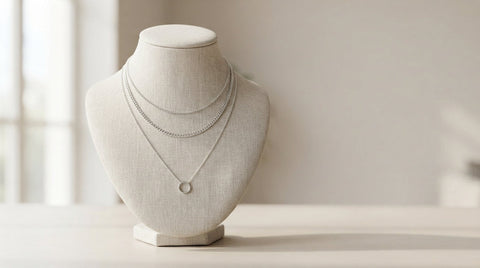

Short answer: skin turns green when copper in a piece reacts with sweat, lotion or soap and leaves a green film behind. The copper can be the whole piece, one part of an alloy, or the base metal under a thin plating that has worn through. A Nebraska Medicine dermatologist describes the green residue as not harmful and says it washes off with soap and water. Green is not the same as an itchy, red or painful rash, which can point to an allergy or irritation instead. Our reading of the sources is that what is under the surface matters more than the label, and that plating thickness is the detail our listings most often leave out. This guide explains the chemistry, the plating terms, and what to do.
This guide is general information, not medical advice. If you have an itchy, red, swollen or painful reaction to jewelry, see a board-certified dermatologist. Product details in our listings come from our suppliers and we have not verified them. Last updated: November 14, 2026.
About this guide: we are an online store, and we do not test the products we sell. This guide summarizes pages from the Federal Trade Commission, two hospital systems, consumer media articles, a jewelry supplier, an insurer, Mayo Clinic and a 2005 case report, listed at the end. Jewelry suppliers and insurers have a stake, and we say so where it matters. Where a number comes from our own listings, it is the supplier's figure. Prices can change, so check the product page. Where a calculation or suggestion is our own, we label it.
Nebraska Medicine dermatologist Jennifer Adams, MD, explains the green as oxidation, a chemical reaction between copper in the jewelry and substances such as sweat, lotion or other products. She compares it to the green patina that forms on copper-plated pennies and the Statue of Liberty. Copper is the usual culprit, she says, often sitting under a thin layer of silver or gold. A Genesis HealthCare System page, which cites the Nebraska Medicine article, adds that the metal can be solid copper or copper alloyed with other metals, and that price is not the real issue.

| Factor | What the sources say | Source |
|---|---|---|
| Copper | The usual cause of green skin. It can be a solid piece, an alloy ingredient or a hidden base metal. | Nebraska Medicine; Genesis |
| Sweat | Sweat minerals and chemicals react with the copper, and the color transfers to skin. Hot days raise the risk because you sweat more. | Reviewed; Reader's Digest |
| Lotion, soap and sanitizer | These can cause the same reaction even without sweating. | Reviewed; Genesis |
| Water, salty air and household chemicals | A jewelry supplier lists chlorine, sulfur in water, salty air and household chemicals among the contributors. | Halstead (a supplier) |
| Your skin chemistry | The reaction does not happen to everyone or every time. Halstead adds that skin chemistry changes over time, so a ring that never left a mark can start to. | Reviewed; Halstead |
| Price | Genesis says price is not the real issue, so a cheap piece is not automatically the culprit. | Genesis |
Reviewed quotes board-certified dermatologist Suzanne Friedler, MD, a fellow of the American Academy of Dermatology, and adds that copper alloys are often hidden in costume jewelry that is labeled nickel, silver plated or gold plated. That article is from 2019 and describes no testing of its own.
Nebraska Medicine says the green residue is not harmful. Genesis says it is not dangerous and does not describe it as an allergy. Reader's Digest quotes a jewelry maker who calls it residue that can be wiped off, and says itching or a rash after wearing copper jewelry may point to an allergy instead. Those two claims fit together, since a stain on the skin and a reaction in the skin are different things.
Mayo Clinic says a nickel allergy usually causes an itchy rash where the metal touches the skin, and symptoms usually start within a couple of days. A 2005 case report in Patient Care Online describes one woman who developed pain and itching on her neck and chest several hours after putting on a new copper necklace, and who was diagnosed with contact dermatitis to copper. That is one case, and the article does not say how common this is.

| What you see | What the sources suggest | What to do |
|---|---|---|
| A green or blue-green mark that wipes off | Copper reaction. Described as not harmful. | Wash with soap and water. See the prevention section below. |
| A black mark | Halstead says this is usually tarnish from sterling silver, triggered by sulfur in water and similar sources. | Clean the piece. Halstead is a supplier, so treat this as general guidance. |
| Red, itchy or painful skin under the piece | May be an allergy or irritation rather than a stain. Mayo describes an itchy rash for nickel allergy. Halstead says red marks are usually an allergic reaction or irritation, most often to nickel or chromium. | Take the piece off and see a board-certified dermatologist if it persists. Do not treat it as just a stain. |
The sources do not agree on every metal, and we do not test any of them. This table shows what each source says and where they differ.
| Metal or finish | Copper involved? | What the sources say |
|---|---|---|
| Pure copper | Yes, it is copper. | Genesis says solid copper can cause it. One of our copper listings says its metal develops a natural patina over time. |
| Brass, bronze, pewter | Halstead lists them as copper-containing. | Halstead is a jewelry supplier. We found no medical source that tests these. |
| Sterling silver | Halstead lists it as copper-containing. | Genesis says certain silver can cause it. Reader's Digest lists sterling silver among its choices that avoid the problem. The sources differ. |
| Gold below 24 karat | Halstead says it contains copper, with less in higher karats. | Halstead says higher-karat gold is less likely to leave green marks. |
| Gold or silver plated over a base metal | Jewelers Mutual says the base is usually copper or brass. | Nebraska Medicine says the problem often involves copper under a thin layer. Halstead says plating can wear away and expose the base. |
| Gold vermeil | The FTC says the base must be sterling silver. | Jewelers Mutual describes it as more hypoallergenic but less wear resistant than gold filled. Jewelers Mutual is an insurer. |
| Stainless steel, platinum, solid gold | Not described as copper sources in our sources. | Reader's Digest lists these as choices. We found no US source that tested them for this. |

Because plating wears, the terms on a listing matter. Jewelers Mutual says thinner coatings wear sooner. The FTC Jewelry Guides, as published in the Federal Register in 2018, set minimums for specific terms, which we summarize here. The Federal Register page says its text is not an official legal edition, so check the official 16 CFR Part 23 before you rely on it. Our Valentine's Day jewelry gift guide also covers what sterling, plated and stainless steel mean.
| Term | Minimum under the FTC guides | Notes |
|---|---|---|
| Gold electroplate | At least 10 karat gold, with at least 0.175 microns (about 7 millionths of an inch) of fine gold. | A micron is one millionth of a meter. The guides use a karat before the term, such as 12 Karat Gold Electroplate. |
| Heavy gold electroplate | The electroplate minimums above, plus at least 2.5 microns (about 100 millionths of an inch) of fine gold. | Jewelers Mutual puts 2.5 microns at about 28 times thinner than a human hair. |
| Gold plate by mechanical bonding | At least 10 karat, with the plating at least 1/40 of the metal weight of the whole article. | No thickness figure is given. |
| Gold filled | Gold at least 1/20 of the weight of the whole article. | Jewelers Mutual says it is heat-bonded to a copper or brass base. |
| Vermeil | Sterling silver base, gold of at least 10 karat, and at least 2.5 microns of fine gold. | If a base-metal layer sits between the silver and the gold, the product must say so. |
| Gold wash over base metal | A disclosure is required when a thin gold wash covers a primary gold coating that sits over a base metal. | This is about misleading labels, not wear. |
Jewelers Mutual says plated has no set minimum, which does not match how the FTC guides treat the term gold electroplate, so we rely on the FTC text for the numbers. Either way, a phrase such as "14K gold plated" does not tell you the thickness.

This table shows what a few of our listings state about their materials. We are pointing out what is and is not stated, so you know what to check before you order. Three of the copper listings also make magnetic therapy or wellness claims. We make no health claims in this guide and we have not verified those.
| Listing | What the listing says | Price | What to check |
|---|---|---|---|
| Reevaria cuff bracelet | 99.9% pure copper; lead and nickel free; develops a natural patina over time | $51.41 | It is copper by design, which is the metal the sources link to green marks. Whether it marks your skin depends on you and your products. |
| MagnetRX woven cuff | 99.9% pure copper; hypoallergenic claim | $83.39 | The listing mentions a hypoallergenic finish without saying what it is. We cannot verify the claim. |
| Jecanori wristband | Copper; antique finish; hypoallergenic and nickel free claims | $44.86 | The listing does not say whether the finish is coated. We cannot verify the hypoallergenic claim. |
| Ecesha rhinestone bangle | Title says gold plated; the description says copper base and lists copper as a material | $39.71 | This is the pattern the sources describe: plating over copper. No plating thickness is stated. |
| Alton of Sweden cuff | Stainless steel core with 18K gold plating | $91.39 | No plating thickness is stated. |
| MANZHEN Star of David necklace | Stainless steel with 14K gold plating; claims it will not discolor skin | $39.71 | This is a supplier claim we have not verified. No thickness is stated. |
| Queen Jewels cross necklace | 925 sterling silver with 14K gold plating | $63.58 | No thickness is stated, and the listing does not use the word vermeil. |
| Verona herringbone chain | Title says gold plated over silver; the description says 925 sterling silver and does not mention plating | $55.62 | The title and description do not match. Ask which finish you are getting. |
Two things stand out. None of the five plated listings states a plating thickness, and we searched our catalog titles and descriptions for the words vermeil and gold filled and found no listings that use them.
The prevention advice in these sources is consistent, but none of it comes with measured results. Reviewed says its staff use clear nail polish on costume jewelry, and gives no timeframe for how long it lasts. We treat all of this as practical advice, not tested fact.
| Step | What the sources say | Caveat |
|---|---|---|
| Coat the part that touches skin with clear nail polish | Nebraska Medicine, Genesis, Reviewed and Reader's Digest all suggest it as a barrier. Nebraska Medicine says to reapply it periodically. | No source measures how long it lasts. Reviewed says it is hard to tell when it has worn off. |
| Re-plate worn plated pieces | Nebraska Medicine and Reviewed say a jeweler can re-plate once the outer layer has worn off. Reviewed says to skip the polish on plated pieces. | The sources differ on polish for plated pieces. We did not find a US source with re-plating prices. |
| Use a wax or lacquer barrier | Halstead lists beeswax, renaissance wax and a product named ProtectaClear, and says they may need reapplying. | Halstead is a supplier. |
| Take it off before water, lotion and cleaning | Halstead and Reader's Digest suggest removing jewelry before swimming, showering, washing hands, cleaning and applying lotion or perfume. | This is practical advice. No source tests it. |
| Keep skin and jewelry clean and dry | Reader's Digest suggests regular cleaning and dry storage. Halstead suggests washing skin before putting jewelry on. | Reader's Digest names jewelry business owners as its experts, not doctors. |
| Avoid wearing it on hot days | Reader's Digest says heat raises sweating and so raises the risk. | This may not be practical for pieces you wear every day. |
| Choose a piece without copper | Genesis says to choose jewelry without copper. | Labels often do not say. Reader's Digest warns that alloys in fashion jewelry may not be clearly labeled. |

Nebraska Medicine and Genesis both say soap and water usually remove the residue. Genesis adds that an alcohol-based remover can be used if soap and water do not work. Halstead says the discoloration usually fades within a few days, which is a supplier claim. If your skin is red, sore or itchy rather than just stained, stop wearing the piece and see a dermatologist.

These are our suggestions, based on the sources above and not on any test of our own.
| If this is you | Our suggestion | Why |
|---|---|---|
| You want to avoid green marks entirely | Look for a piece that states its base metal, and avoid listings that only say plated | The sources link the problem to copper under the surface, so the base metal and plating thickness are the details to look for. |
| You like the look of copper | Expect to manage it with a barrier, cleaning and dry storage | The sources describe copper as the metal that reacts, and one of our listings says its copper develops a patina. |
| You want a gold look that lasts | Ask the seller for the plating karat and thickness | The FTC guides set minimums for specific terms, and none of our five plated listings gave a thickness. |
| You wear one piece every day | Check the plating often and re-plate or replace it when the base shows | Jewelers Mutual says thinner coatings wear sooner. |
| Your skin gets red or itchy | See a dermatologist before you buy another piece | That is a different problem from a green stain. |
You can browse more in our cuff bracelet, silver chain necklace and jewelry and watches collections.
Our shipping policy explains how delivery works, and our refund policy explains returns, including what can and cannot be returned. Read both before you order, especially if you are buying a piece you have not worn before.
Nebraska Medicine says the residue is not harmful and washes off with soap and water. If you also have itching, redness or pain, that may be a different problem, so see a dermatologist.
Halstead says gold below 24 karat contains copper, and that plating can wear away and expose the base metal. Nebraska Medicine describes copper under a thin layer as a common cause. A supplier source and a hospital source agree on the general pattern, but neither tests your piece.
The sources differ. Genesis says certain silver can cause it, and Halstead lists sterling silver as copper-containing. Reader's Digest lists sterling silver among its choices that avoid the problem. It likely depends on the piece and on you.
Our sources do not describe stainless steel as a copper source, and Reader's Digest lists it as a choice. We found no US source that tested it for this, and a gold plating over stainless can still wear.
Not by itself. Reader's Digest says the green color is not a skin reaction, and that itching or a rash may signal an allergy. Mayo Clinic describes an itchy rash for nickel allergy. See a dermatologist if you are unsure.
Several sources suggest it as a barrier, and Nebraska Medicine says to reapply it periodically. None of them gives measured results or a timeframe, so treat it as practical advice.
Soap and water usually work, per Nebraska Medicine and Genesis. Genesis adds that an alcohol-based remover can be used if they do not.
Genesis says price is not the real issue. What matters is whether copper is in the piece or under the plating, so look for a stated metal and plating thickness instead of relying on the price.
No. We are an online store. Product details come from our suppliers, and we have not verified them.
Green skin is a copper reaction that the sources describe as not harmful and as washable with soap and water. It is different from an itchy or painful rash, which deserves a dermatologist. Copper can be the whole piece, an ingredient or the layer under a plating that has worn through, so look for listings that name the base metal and the plating thickness. Browse our cuff bracelets and silver chain necklaces, and read our shipping policy and refund policy before you order.


