

No Products in the Cart

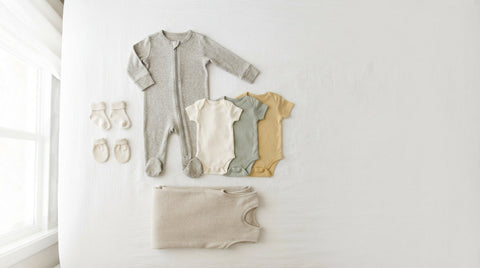

Short answer: baby clothes are labeled by age but sized by weight and length, so your baby's birth month decides which sizes land in which weather. Carter's says its sizes are based mainly on weight and length, not the age on the tag. Babies grow fastest early on: Mayo Clinic says most triple their birth weight by their first birthday, and the pages we read put doubling somewhere between 4 and 6 months. In our own illustration, a baby born in November is in the 3M label (0 to 3 months) in January, the 6M label around April, 9M around July and 12M around October. Carter's and Boody suggest a handful of newborn pieces and more in the next size, while Babylist and Huckleberry caution against buying too many sizes, or seasonal pieces, far ahead. Babies vary by a full size either way, so use the brand's chart and your baby's current weight and length.
This guide is general information, not medical advice, and no source we read tested a birth month wardrobe plan on real babies. Product details in our listings come from our suppliers and we have not verified them. If you have concerns about your baby's growth, talk to your pediatrician. Last updated: November 16, 2026.
About this guide: we are an online store and we sell baby clothes, so we have a commercial interest in this topic. We do not test the products we sell. This guide summarizes pages from Mayo Clinic, Nemours KidsHealth, MedlinePlus (a service of the US National Library of Medicine), the American Academy of Pediatrics (AAP) on HealthyChildren.org, size charts hosted by Target for Carter's and Baby Vision (Hudson Childrenswear), and pages from Carter's (a clothing brand), Primark US (a clothing retailer), Boody (a clothing brand), Babylist (a baby registry and shopping company) and Huckleberry (a company that sells a baby sleep app), listed at the end. Brand and retailer pages have a commercial interest in selling clothes. Where we quote a number from one of our own listings, it is the supplier's figure. Prices can change, so check the product page. Where a suggestion, a calculation or a reading is our own, we label it.
| Question | What the sources say | Source |
|---|---|---|
| Are baby sizes by age or by weight? | Labeled by age, but based mainly on weight and length. Carter's 3M label generally matches the 0 to 3 months range other brands use | Carter's size guide |
| How long in newborn size? | Typically 2 to 4 weeks, up to about 6 weeks for smaller babies (Huckleberry). Zero to four weeks, up to 8 weeks for smaller babies, and larger babies may skip it (Boody, a clothing brand) | Huckleberry; Boody |
| When does weight double and triple? | Double: by 4 months for many babies (KidsHealth), 4 to 6 months (MedlinePlus), about 6 months (AAP). Triple: by the first birthday (Mayo Clinic) or around 1 year (AAP) | KidsHealth; MedlinePlus; AAP; Mayo Clinic |
| How much length in year one? | About 9.5 inches (Mayo Clinic); about 10 inches (KidsHealth). Roughly 1 inch a month to about 6 months, then about half an inch a month | Mayo Clinic; KidsHealth |
| Typical weight per size? | 3M: 8 to 12.5 lb. 6M: 12.5 to 16.5 or 17 lb. 9M: 16.5 or 17 to 20.5 or 21 lb. 12M: 20.5 or 21 to 24.5 or 25 lb. The charts differ at the edges | Target-hosted Carter's chart; Primark US; Carter's blog |
| How should a baby be dressed? | About one more layer than you would wear (AAP safe sleep, 2026). Thin layers rather than bulky coats in a car seat (AAP). Babies under 6 months should stay out of direct and indirect sunlight (AAP, April 2026) | AAP HealthyChildren.org |
| Do our listings show every size? | No. Each of the 10 listings we read has one size option on our product page, though 6 descriptions list a wider range | Our reading of the listings |

The pages agree that sizes follow weight and length more than age and that the size in a given season is hard to predict. They differ on how many pieces to buy, how long newborn size lasts, and whether to plan seasonal sizes ahead.
| Source | What it says | Date shown | Note |
|---|---|---|---|
| Carter's, Kids' Size Guide and How Many Baby Clothes Do I Need | Sizes are typically based on weight and length, not the age on the tag. Carter's 6M generally fits 12.5 to 17 pounds and 24 to 27 inches. Buy just a handful of newborn pieces and invest more in 3M | Size guide: no date shown. Blog: updated May 28, 2026 | Clothing brand; the blog's table has two rows that look like typos (see the charts section) |
| Target-hosted charts for Carter's and for Baby Vision (Hudson Childrenswear) | Size, height and weight from NB through 24M, with age labels on the Baby Vision chart | No date shown | Retailer-hosted brand charts; they match each other for baby sizes |
| Primark US, baby clothes sizes | Weight and height guideline by age from newborn to 18 to 24 months | September 3, 2024 | Clothing retailer |
| Mayo Clinic, Infant growth: What's normal? | Most babies triple birth weight by the first birthday; about 9.5 inches of length in year one | September 23, 2025 | Mayo Clinic Staff; no reviewer named |
| Nemours KidsHealth, Your Child's Growth and Your Baby's Growth: 4 Months | About 10 inches and triple birth weight in year one. Many babies have doubled birth weight by 4 months | Reviewed June 2022 and May 2023 | Reviewed by Madhu Desiraju, MD, and Amy W. Anzilotti, MD |
| MedlinePlus, Normal growth and development | Normally loses about 10% to 12% of birth weight soon after birth. Weight should double by 4 to 6 months | January 1, 2026 | Updated by Charles I. Schwartz, MD, FAAP; published by A.D.A.M. |
| AAP HealthyChildren.org, Understanding Growth Charts | Baby will double weight by about 6 months and triple it by around 1 year | Last updated March 16, 2026 | By Nicole Anania, DO, MS, FAAP |
| Babylist, How Many Baby Clothes Do I Need and Baby Capsule Wardrobe | Plan seasonal sizes from the due date, but also hold off on seasonal pieces until closer to use. Buy a few newborn and 0 to 3 month pieces | Updated October 7, 2026 | Registry and shopping company; a fact checker is named, not a medical reviewer |
| Huckleberry, How Many Baby Clothes Do You Need | Newborn size is usually worn 2 to 4 weeks; avoid buying too many sizes ahead | Updated September 3, 2026 | Reviewed by Alan Salem, MD, FAAP; the company promotes its own app |
| Boody, How Long Do Babies Stay in Newborn Clothes | Most babies wear newborn size zero to four weeks; invest more in 0 to 3 months | November 12, 2026 | Clothing brand promoting its baby range; gives two timings for moving up |
| AAP HealthyChildren.org pages on dressing, sleep, car seats, sun and heat | One more layer than an adult; thin layers in the car seat; keep babies under 6 months out of direct and indirect sunlight | June 2016 to September 2026 (see the seasons section) | Written for specific situations; the 2016 page is about 10 years old |

Three published charts, converted to the same layout. The age labels in the first column are the ones Carter's and Baby Vision use for these sizes. Weights are in pounds and heights in inches.
| Size (age label) | Carter's chart on Target | Carter's blog (carters.com) | Primark US |
|---|---|---|---|
| NB (newborn) | 5 to 8 lb; up to 21.5 in | 6 to 9 lb; 18 to 21.5 in | Up to 8 lb; up to 21.5 in |
| 3M (0 to 3 months) | 8 to 12.5 lb; 21.5 to 24 in | Row shows 6 to 9 lb and 21.5 to 24 in (the weight repeats the NB row and looks like a typo) | 8 to 12.5 lb; 21.5 to 24 in |
| 6M (3 to 6 months) | 12.5 to 16.5 lb; 24 to 26.5 in | 12.5 to 17 lb; row shows 21.5 to 24 in (looks like a typo; the Carter's size guide says 24 to 27 in) | 12.5 to 17 lb; 24 to 27 in |
| 9M (6 to 9 months) | 16.5 to 20.5 lb; 26.5 to 28.5 in | 17 to 21 lb; 27 to 28.5 in | 17 to 21 lb; 27 to 28.5 in |
| 12M (9 to 12 months) | 20.5 to 24.5 lb; 28.5 to 30.5 in | 21 to 25 lb; 28.5 to 30 in | 21 to 25 lb; 28.5 to 30.5 in |
| 18M (12 to 18 months) | 24.5 to 27.5 lb; 30.5 to 32.5 in | Not listed | 25 to 28 lb; 30.5 to 32.5 in |
| 24M (18 to 24 months) | 27.5 to 30 lb; 32.5 to 34 in | Not listed | 28 to 30 lb; 32.5 to 34 in |
The Baby Vision chart at Target uses the labels S (0 to 3 months), M (3 to 6), L (6 to 9), XL (9 to 12), 18M (12 to 18) and 24M (18 to 24), and its weights and heights match the Carter's Target chart row by row. Carter's labels run P, N, then 3M, 6M and so on, and Carter's says its 3M compares to the 0 to 3M range at other brands.
Our reading: the charts differ by about half a pound or half an inch at the edges, and the newborn range is the least settled (5 to 8 pounds on Target's chart, 6 to 9 on the Carter's blog, up to 8 on Primark's). A baby at the edge of two sizes can fit either, so check the chart for the brand you are buying.
| Topic | What the sources say | Source |
|---|---|---|
| Early dip | An infant normally loses about 10% to 12% of birth weight soon after birth and should start gaining by about 2 weeks | MedlinePlus, January 1, 2026 |
| Daily weight gain | About 1 ounce (28 grams) a day in the first few months, slowing to about 20 grams a day around 4 months and about 10 grams or less around 6 months (about 0.7 and about 0.35 ounce, our conversions) | Mayo Clinic, September 23, 2025 |
| Doubling birth weight | By 4 months for many babies; 4 to 6 months; about 6 months. The pages do not agree | KidsHealth, May 2023; MedlinePlus; AAP, March 2026 |
| Tripling birth weight | By the first birthday for most babies; around 1 year | Mayo Clinic; KidsHealth; AAP |
| Length | About 1 inch a month from birth to about 6 months, then about half an inch a month from 7 to 12 months. About 9.5 inches in year one (Mayo) or about 10 inches (KidsHealth) | Mayo Clinic; KidsHealth, June 2022 |
Our arithmetic, using the rules of thumb above and the Carter's chart hosted by Target. The three birth weights are examples we chose, not averages, and doubling and tripling are rules of thumb that many babies follow, not guarantees.
| Example birth weight | Doubled (4 to 6 months) | Size by weight | Tripled (about 12 months) | Size by weight |
|---|---|---|---|---|
| 6 lb | 12 lb | 3M (8 to 12.5 lb) | 18 lb | 9M (16.5 to 20.5 lb) |
| 7 lb | 14 lb | 6M (12.5 to 16.5 lb) | 21 lb | 12M (20.5 to 24.5 lb) |
| 8 lb | 16 lb | 6M (12.5 to 16.5 lb) | 24 lb | 12M (20.5 to 24.5 lb) |
Our reading: a smaller baby can run a full size behind the age label, and a larger one a size ahead. On Mayo's length figures, a 20 inch newborn (our assumption) would be about 26 inches at 6 months and about 29 to 30 inches at 12 months, which falls in the same 6M and 12M brackets as the 7 pound example. Because the charts overlap at the edges, a weight at the top of one bracket can sit in the next on another brand's chart.

This planner is ours; no source we read published one. We took the age labels Carter's and Baby Vision use (3M is 0 to 3 months, 6M is 3 to 6, 9M is 6 to 9, 12M is 9 to 12) and worked out your baby's age at the middle of each season: January, April, July and October, counted from the first such month on or after the birth month. Where the age falls exactly on 3, 6 or 9 months, either neighboring size may fit, and at 0 or 1 month some babies are still in newborn size. A baby born between those months, such as in February, also spends the first weeks of the season in newborn sizes, which the table does not show.
| Birth month | Mid-winter (January) | Mid-spring (April) | Mid-summer (July) | Mid-fall (October) |
|---|---|---|---|---|
| January | NB or 3M (age 0) | 3M or 6M (age 3) | 6M or 9M (age 6) | 9M or 12M (age 9) |
| February | 12M (age 11) | 3M (age 2) | 6M (age 5) | 9M (age 8) |
| March | 12M (age 10) | NB or 3M (age 1) | 6M (age 4) | 9M (age 7) |
| April | 9M or 12M (age 9) | NB or 3M (age 0) | 3M or 6M (age 3) | 6M or 9M (age 6) |
| May | 9M (age 8) | 12M (age 11) | 3M (age 2) | 6M (age 5) |
| June | 9M (age 7) | 12M (age 10) | NB or 3M (age 1) | 6M (age 4) |
| July | 6M or 9M (age 6) | 9M or 12M (age 9) | NB or 3M (age 0) | 3M or 6M (age 3) |
| August | 6M (age 5) | 9M (age 8) | 12M (age 11) | 3M (age 2) |
| September | 6M (age 4) | 9M (age 7) | 12M (age 10) | NB or 3M (age 1) |
| October | 3M or 6M (age 3) | 6M or 9M (age 6) | 9M or 12M (age 9) | NB or 3M (age 0) |
| November | 3M (age 2) | 6M (age 5) | 9M (age 8) | 12M (age 11) |
| December | NB or 3M (age 1) | 6M (age 4) | 9M (age 7) | 12M (age 10) |
How to read it: a baby born in November is about 2 months old in January (3M label), 5 months old in April (6M), 8 months old in July (9M) and 11 months old in October (12M). In the second year, the labels continue as 18M (12 to 18 months) and 24M (18 to 24 months). The planner uses age labels only. Your baby's weight and length, and the brand's chart, decide the actual size.
By season of birth: Babylist says a baby due in January needs warm-weather clothes in the size the baby will be in summer, and a baby due in summer needs cold-weather items such as booties, a warm bunting and mittens. By our planner, a January baby is at 6M or 9M in July, an April baby is at 3M or 6M in July and 9M or 12M the next January, a July baby is at 6M or 9M in January, and an October baby is at 3M or 6M in January.
Our reading: Babylist's advice pulls two ways. Its how-many page plans seasonal sizes from the due date, while its capsule wardrobe page says to hold off on seasonal pieces because the size in a given season is hard to predict, and Huckleberry says larger sizes may not line up with the season. Our suggestion is to use the planner to know which size to look for, then buy the seasonal piece once your baby's weight shows which size is next.

| Situation | What the AAP pages say | Date shown |
|---|---|---|
| Hot weather | You can reduce clothing to a single layer above 75 degrees Fahrenheit; a good rule of thumb is one more layer than you are wearing | June 17, 2016 (about 10 years old) |
| Cold weather | Below 75 degrees Fahrenheit, several layers: an undershirt and diaper, pajamas or a gown, then a receiving blanket, with a wearable blanket or sleep sack as an extra layer. A premature baby may need another layer until reaching full-term weight | June 17, 2016 |
| Sleep | Only one more layer than you would wear. Check for sweating, a hot chest or flushed skin. A wearable blanket is an option. No hat indoors once home from the hospital. Stop swaddling when your baby looks like they are trying to roll over, usually around 3 to 4 months | September 11, 2026 |
| Car seat | Thin layers; remove coats and blankets before buckling and drape them over the straps; if you can pinch the harness straps, tighten them. Bulky clothing, including winter coats and snowsuits, can compress in a crash and leave the straps too loose | February 28, 2025; April 16, 2026 |
| Outdoors in the cold | Several thin layers, warm boots, gloves or mittens and a hat. The one more layer rule is stated for older babies and young children | January 25, 2023 |
| Sun | Lightweight long sleeve clothing, long pants and wide brimmed hats. Babies younger than 6 months should be kept out of direct and indirect sunlight entirely because of the risk of heat stroke. Avoid 10 a.m. to 4 p.m. Sunscreen on uncovered areas from 6 months | April 13, 2026 |
| Extreme heat | Loose fitting clothing; light colors stay cooler, though darker colors give slightly better sun protection. A heat index at or above 90 degrees Fahrenheit can be dangerous, especially for babies (written for children generally) | June 30, 2026 |
Our reading: the pages are not identical. The 2016 page allows a single layer above 75 degrees Fahrenheit, the 2026 sleep page says one more layer than you would wear, and the cold weather page applies that rule to older babies. For clothing, this suggests thin, removable layers in every season, and outerwear that comes off before the car seat. Your pediatrician can advise on layers for your baby. For more on sleep, see our guide to dressing a baby for sleep in winter.
| Source | Counts | Note |
|---|---|---|
| Babylist (October 7, 2026) | Per current size, with laundry every 2 to 3 days: 7 bodysuits or rompers, 3 to 5 pants, 4 sleepers, footies or gowns, 2 hats, 5 pairs of socks (2 more if due in winter), 2 to 3 swaddles | Double the bodysuits and sleepers if you wash weekly; fewer if daily |
| Carter's (May 28, 2026) | Bodysuits 8 to 10, sleep and plays 6 to 8, sleeper gowns 4 to 5, pants 5 to 7, socks 8 to 10 pairs, hats 2, cardigans or jackets 2, 1 bunting or snowsuit for cold climates | By item, not by size; a clothing brand |
| Huckleberry (September 3, 2026) | Newborn stage: bodysuits 6 to 10, pajamas and footies 4 to 7, pants 3 to 5 (optional), socks 4 to 6 pairs, hats 1 to 2, outerwear 1 to 2 (typically optional) | Medically reviewed; company sells an app |
| Boody (November 12, 2026) | Newborn: 4 to 5 pieces at most. 0 to 3 months: 7 to 10 pieces. 3 to 6 months: 5 to 7 pieces | A clothing brand |
| How long in each size | What the sources say |
|---|---|
| Newborn | Typically 2 to 4 weeks, up to about 6 weeks for smaller babies (Huckleberry). Zero to four weeks, skipped by larger babies, up to 8 weeks for smaller ones (Boody) |
| 0 to 3 months | Babies over about 8 to 9 pounds may fit right away (Huckleberry). From birth for larger babies, or about 4 to 8 weeks through roughly 3 months (Boody) |
| 3 to 12 months | 3 to 6 months is where you get the most wear, and growth slows somewhat from 6 to 12 months (Boody). Babylist gives no durations |
Our reading: the counts differ by about a factor of two, partly because laundry frequency differs, and Boody gives both 4 to 6 weeks and 4 to 8 weeks for moving up from newborn size. Our suggestion is to buy toward the low end for the first month and add pieces in the size your baby is actually wearing.
| Source type | What it is | How we read it |
|---|---|---|
| Mayo Clinic, KidsHealth, MedlinePlus, AAP | Health organization pages on growth and on dressing babies | Useful rules of thumb; they disagree on when weight doubles; the AAP pages range from 2016 to 2026; none is about choosing sizes |
| Brand and retailer charts, and company blogs | Carter's, Target-hosted charts, Primark US, Babylist, Huckleberry, Boody | Practical but set by each company; edges differ; counts and timings are opinions, not tests |
Our reading: the sources agree that size follows weight and length, that growth is fastest in the first months and that predicting a season's size is difficult. None tested a birth month plan. The planner is our arithmetic on published age labels, and the weight examples apply rules of thumb that many babies, but not all, follow. Your pediatrician's growth chart for your baby is the better guide.
| Check | What to look for | Why it matters |
|---|---|---|
| Size option | The size in the option selector, and whether it matches the title | Titles can name one size while the option shows another; each listing here has one option |
| Weight and length | The brand's own chart, not just the age label | Carter's says sizes are based mainly on weight and length, and charts differ by brand |
| Season and thickness | Fabric, lining, sleeve length and any warmth claim | The AAP advises about one more layer than you would wear, so a very warm piece suits cold weather only |
| Outerwear | Whether it comes off easily before the car seat | The AAP says bulky coats and snowsuits can leave harness straps too loose |
| Sun, fiber and certification claims | A fabric, a rating or a certificate number behind the words | Without one, it is a supplier claim we cannot verify; many listings give no care instructions |
| Title and text that disagree | Newborn versus a month range, brands, fibers | Several listings below have one; ask before you order |

These are 10 of our active baby listings, read in full on November 16, 2026, chosen to cover warm weather, cold weather and everyday wear. The figures are the suppliers' figures. We have not verified or tested any of them, and you should check the product page for the current version. Prices are the lowest price shown. Each listing has a single size option on our product page, even where its description lists several sizes.
| Listing | Price | Size and details as listed | What to check |
|---|---|---|---|
| Hudson Baby quilted zipper sleep and play, 0 to 3 months | $38.89 | Premium quilted cotton; one piece; the text says it gives a warm and comfortable environment for naps and bedtime | No fabric weight or warmth rating; the AAP says to check a sleeping baby for sweating, a hot chest or flushed skin; no care instructions |
| Hudson Baby newborn arctic bodysuit | $38.55 | Soft cotton; one piece; size option 0 to 3 months | The title says Newborn while the option is 0 to 3 months; no sleeve length, closure or season; no care instructions |
| PARADE organic snuggle soft romper with mitts, 0 to 3M | $54.35 | "100% GOTS certified Organic cotton"; two-way zipper; fold-over cuffs; zipper guard; described for cooler nights | No certificate number; no care instructions; the highest price here |
| Organic cotton footie romper, newborn preemie 6 to 9 months | $29.78 | 100% organic cotton; two-way zipper; mitten cuffs on newborn to 12 months; snug fit; care: machine wash delicate in cold water, tumble dry low or line dry | The title names Newborn, Preemie and 6 to 9 months while the option is 6 to 9 months; the text lists 0 to 3 through 9 to 12 months; no named certification |
| Unisex cartoon print long sleeve romper, 9 to 12 months | $29.78 | 100% cotton; two-way zipper with guard; roomy fit; machine washable | The title says Newborn outfit and 9 to 12 months; the text says 0 to 12 months; "without harsh chemicals or pesticides" is a supplier claim |
| Winter snowsuit, bear romper, hooded, 9 to 12 months | $38.55 | Polar fleece and cotton; hood with bear ears; fold-over mittens and footies; described for chilly autumn and winter days; text sizes 0 to 3m through 12 to 18m | The title says Newborn but the option is 9 to 12 months, and calls it coat outerwear; the AAP says bulky snowsuits can leave car seat straps too loose; no care instructions |
| CAHL&FAUO warm snowsuit, fleece hooded romper, 0 to 3M | $47.33 | Polar fleece with a cotton fleece lining; hood with bear ears and tail; full zipper; elasticized cuffs | The text claims year-round use, including rainy summer days; our reading is that a fleece hooded suit is a cold-weather piece; no sizes or care instructions in the text |
| Baby girl lace romper, sleeveless, summer, 6 to 12 months | $30.72 | Cotton blend; sleeveless, backless, smocked; snap closure; includes a headband; described for warm summer days | The title says Newborn but the option is 6 to 12 months; sleeveless leaves arms uncovered, and the AAP advises long sleeves for sun (our reading: shade or indoor wear); blend not specified |
| Kupretty summer 3 piece set, ruffle knit romper and bloomers, 12 to 18 months | $39.84 | Cotton blend; sleeveless ribbed romper; snap closure; elastic waist bloomers; headband | The text lists 0 to 3 months through 12 to 18 months and 24 months, with no 18 month size; blend not specified |
| niceclould short sleeve zipper swimsuit, 6 to 12 months | $36.80 | Short sleeve one piece; front zipper; described as sun protection swimwear; text sizes 0 to 6M through 2 to 3T | The title says Toddler; no UPF rating or fabric, so the sun protection claim is a supplier claim; the AAP says babies under 6 months should stay out of direct and indirect sunlight |
| Your situation | Prioritize | Why |
|---|---|---|
| Baby due in winter | A few newborn and 0 to 3 months pieces in thin layers, then summer sizes later | Babylist suggests planning warm-weather clothes for the summer size, while our planner shows a January baby at 6M or 9M in July; Babylist and Huckleberry also say not to buy seasonal sizes too early |
| Baby due in summer | Lightweight long sleeve cotton, a wide brimmed hat and shade | The AAP advises these for sun, and our planner shows a July baby at 6M or 9M in January for the first cold-weather items |
| You expect a larger baby | Few or no newborn pieces and more in 0 to 3 months | Boody says larger babies may skip newborn size, and Huckleberry says babies over about 8 to 9 pounds may fit 0 to 3 months right away |
| A smaller baby or a premature baby | Newborn size, and your pediatrician's advice on warmth | Boody says smaller babies may wear newborn size up to 8 weeks, and the AAP says a premature baby may need another layer until reaching full-term weight |
| A gift for a new baby | 3 to 6 or 6 to 12 month sizes, which is Boody's advice | Newborn size is worn briefly; see our baby shower gift size guide |
| A budget under $40 | Eight of the listings above: from the cartoon and organic footie rompers ($29.78) to the Kupretty set ($39.84) | The CAHL&FAUO snowsuit is $47.33 and the PARADE romper is $54.35 |
These items are listed in our baby clothes collection and our baby zipper romper collection. We do not test them, so use the checks above and the brand chart.
Our shipping policy explains how delivery works, and our refund policy explains returns, including what can and cannot be returned. Read both before you order, and check the size option and the brand chart first.
Carter's and Boody suggest a handful of newborn pieces and more in the next size up, and Babylist suggests a few of each. Huckleberry says babies over about 8 to 9 pounds may fit 0 to 3 months right away.
Huckleberry says typically 2 to 4 weeks, up to about 6 for smaller babies. Boody says zero to four weeks, and up to 8 for smaller ones.
Both are printed, but Carter's says baby sizes are typically based on weight and length, not the age on the tag, and that not every 6-month-old fits the 6M range.
It depends on weight and length. The pages we read put doubling of birth weight between 4 and 6 months and tripling at about a year; our arithmetic with a 7 pound example gives 6M by weight at 4 to 6 months and 12M at a year. A smaller baby may run a size behind, a larger one a size ahead.
Babylist suggests planning from the due date but its capsule wardrobe page also says to hold off on seasonal pieces, and Huckleberry says larger sizes may not match the season your baby fits them. Our suggestion is to use the planner to know the size to look for, then buy when your baby's weight points to it.
The AAP says to use thin layers, remove coats and blankets before buckling and drape them over the straps afterward, and tighten the harness until you cannot pinch the strap. It says bulky clothing, including winter coats and snowsuits, can compress in a crash and leave the straps too loose.
The AAP advises lightweight long sleeve clothing, long pants and wide brimmed hats, and says babies younger than 6 months should be kept out of direct and indirect sunlight entirely. It also says a heat index at or above 90 degrees Fahrenheit can be dangerous, especially for babies.
The AAP says to dress babies in wide brimmed hats for sun and a hat for cold weather outings, but not to put a hat on your baby indoors once home from the hospital. The same page notes that overheating can increase the risk of SIDS.
No. We are an online store. Product details come from our suppliers, and we have not verified them.
Sizes follow weight and length more than age, and the season your baby is born in shapes which sizes meet which weather. Use the planner to know the size label to expect, buy a few pieces at first, and add the next size when your baby's weight and the brand's chart point to it. Use thin, removable layers, and ask your pediatrician about growth and warmth. Browse our baby clothes collection, and read our baby clothes size chart guide for sizes by weight and height. Our shipping policy and refund policy explain delivery and returns.


